Protein & Satiety
The Satiety Signal: Protein Across the Day
Tobias Marsden · 28 February 2026 · 11 min read

The way a person eats rarely changes in a single meal. It changes across dozens of meals, across weeks of small adjustments — a swap from white rice to brown, from a soft white sandwich to rye, from instant oats to rolled. These are not dramatic interventions. They are quiet changes in grain selection, and their relationship to body weight over time is worth examining carefully.
A whole grain retains all three parts of the original seed: the bran, the germ, and the endosperm. The bran carries the majority of the dietary fibre along with B vitamins and mineral content. The germ contains vitamin E and unsaturated fatty acids. The endosperm, the portion that remains when a grain is refined, holds most of the starch and little else.
When a grain is milled to produce white flour, the bran and germ are removed. The resulting product delivers energy without the fibre or micronutrients that accompanied it in the whole form. From a nutrient density standpoint, a serving of whole grain oats and a serving of processed oat cereal deliver meaningfully different compositions even when the calorie counts appear comparable.
This distinction — between calorie count and nutrient density — is central to understanding why food quality over quantity tends to produce more predictable outcomes in the long term than simple calorie arithmetic.
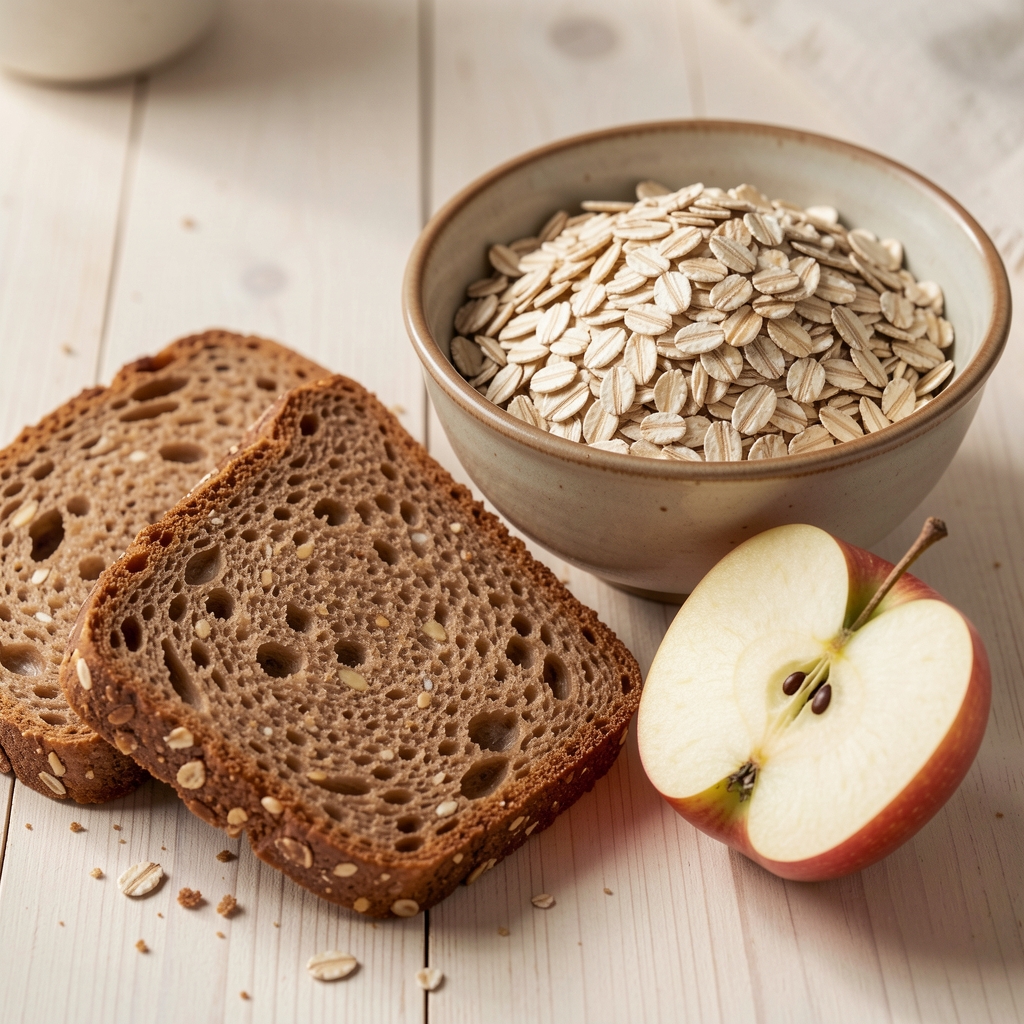
Dietary fibre — present in quantity in whole grains — contributes to fibre and fullness in two distinct ways. Soluble fibre, found in oats and barley, forms a viscous gel in the digestive tract that slows the rate at which glucose enters the bloodstream. This modulates the energy signal the body receives after eating, extending the period before hunger returns. Insoluble fibre, present in wheat bran and rye, adds bulk that accelerates gastric transit and supports consistent gut rhythm.
For anyone observing their eating patterns in relation to weight, this mechanism is relevant. A morning meal anchored by rolled oats rather than processed breakfast cereal tends to produce a sustained satiety response that extends into the mid-morning hours. The practical result is fewer unplanned eating occasions before the next structured meal — a contribution to portion perspective that does not require calorie tracking to achieve.
Published nutritional research consistently associates higher whole grain intake with lower body weight over time, though the relationship is observed rather than strictly causal. Whole grain consumers also tend to follow eating patterns characterised by lower processed food consumption — the grain choice may be a marker of a broader long-term eating rhythm rather than a standalone mechanism.
"The grain choice may be a marker of a broader long-term eating rhythm rather than a standalone mechanism."
Eleanor Whitfield — Atevo Almanac, March 2026
The carbohydrate role in weight is frequently simplified in popular writing. Carbohydrates are not uniquely responsible for weight change; they are the body's primary fuel source and contribute to weight management in complex ways that depend on type, quantity, and the dietary context in which they appear.
Whole grain carbohydrates behave differently from refined grain carbohydrates in several documented respects. Their glycaemic response — the rate at which blood glucose rises following consumption — tends to be more gradual, a consequence of their fibre content and structural integrity. This slower response is associated with reduced hunger signalling in the hours after eating, which connects back to portion perspective and meal structure.
A diet that replaces refined grains with whole grains — without altering portion sizes or total energy intake — has been observed in multiple population studies to result in modest reductions in body weight over a period of months. The mechanism is likely a combination of increased fibre intake, altered satiety signalling, and the indirect effects of swapping processed food for less processed alternatives.
In practical terms, shifting toward whole grain choices does not require dramatic restructuring of daily meals. The most straightforward observations from nutritional field notes suggest a few consistent patterns among those whose eating habits align with whole grain consumption:
Perhaps the most important observation about whole grain consumption and its relationship to body weight is that it functions as a habit within a broader eating rhythm, not as a standalone food with predictable effects. A person who eats rolled oats for breakfast but follows that meal with a day of high-sugar, processed food is unlikely to see the kind of weight pattern observed in populations with consistently high whole grain intake.
What the research more accurately describes is a pattern: people who regularly choose whole grains tend to construct meals that are structured around less processed ingredients across the board. Their long-term eating rhythm includes more fibre, more mineral content, and more protein and satiety pairing — because whole grains typically appear alongside vegetables, legumes, and protein sources rather than in isolation.
The balanced plate approach that many nutritional researchers describe is not about careful weighting of each element but about consistent pattern-making across days and weeks. Whole grains are one reliable anchor point for that pattern. Their contribution to the food and weight connection is real, documentable, and — crucially — accessible without requiring complex calculation or dramatic dietary overhaul.
One practical difficulty with whole grain selection in a retail context is labelling ambiguity. A product described as containing whole grain flour may contain as little as 10% whole grain by weight; the remainder may be refined flour with added fibre. The term "multigrain" describes the number of grain species present, not their processing status — a multigrain loaf may be composed entirely of refined flours from several sources.
For practical purposes, whole grain products are most reliably identified when the first ingredient listed is a whole grain flour or whole grain cereal — "whole wheat flour", "wholemeal rye flour", "whole oat flour" — rather than simply "flour" with whole grain listed further down the ingredients panel. Ingredient order by weight is mandatory in UK food labelling, making this a reliable if imperfect guide.
Articles published on Atevo Almanac are editorial in nature and reflect the writers' observations on everyday wellness practices. The content is not intended as professional advice, nor as guidance for the management of any specific condition. Readers with specific concerns about their daily routines are encouraged to speak with a qualified wellness professional.

Eleanor Whitfield is a contributing editor at Atevo Almanac, covering eating patterns, grain-based nutrition, and the interaction between food structure and long-term body weight. Her writing draws on published nutritional research and field observation across domestic and institutional food environments.
More from this author →